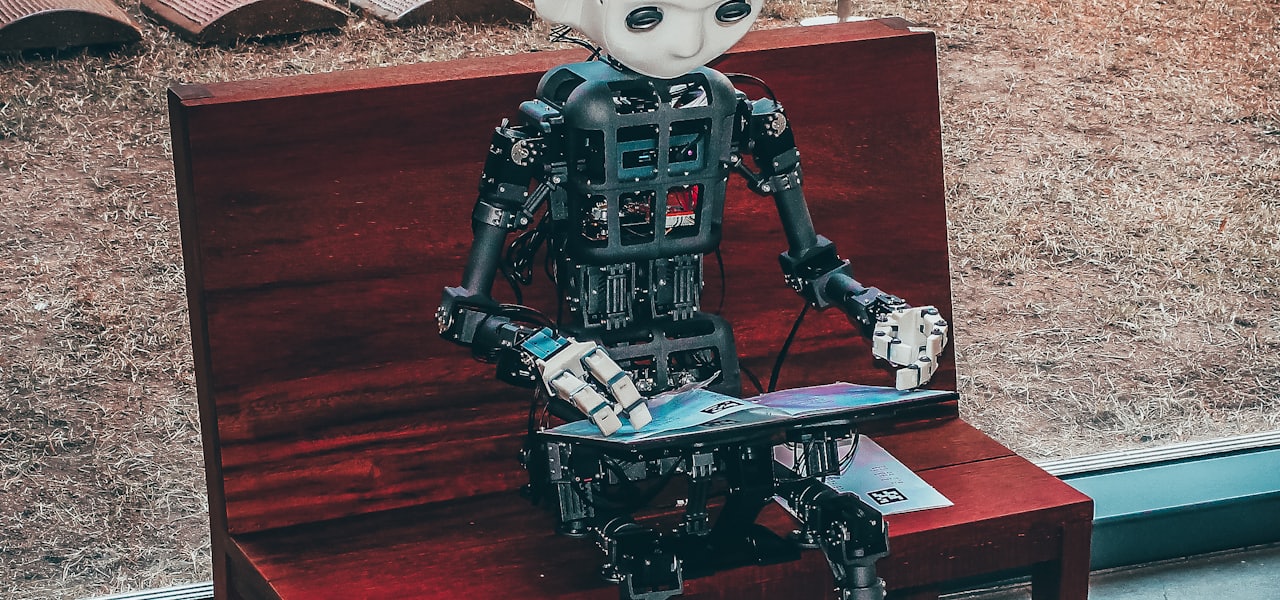
"Lymphater's Formula" (Polish: "Formula Lymphatera") is a 1961 science fiction short story by Polish writer Stanisław Lem. It is a story of a "mad scientist", mathematician Ammon Lymphater, who invents an artificial intelligence, and then he realizes that it is capable of rendering the humankind obsolete. It was first published in the 1961 collection Księga robotów (Book of Robots) with the pre-annotation "from the memoirs of Ijon Tichy". The story was never republished with this pre-annotation, and nothing in the novel gives any indication at Ijon Tichy. Piotr Krywak tried to figure out possible explanations for this, apart from a typographical error. == Plot == Ammon Lymphater became interested in the emerging science of cybernetics and information theory, and started studying the works of an animal brain, the ant's brain in particular. He took note that the inherited knowledge is an evolutionary advantage somehow not exploited in full by the evolution. Eventually he came to a conclusion that only by pure biological restrictions that adaptive abilities of insects were stopped in their tracks by the evolution. He went on further wondering whether the ants have an ability to apriori knowledge, i.e., knowledge neither inherited nor learned. He decided to consult a famous myrmecologist, who told him about a rare ant species Acanthis Rubra Willinsoniana with an exceptionally high adaptability. Eventually Lymphater devised and constructed "It" capable of instant precognition of everything within "Its" rapidly expanding range of perception. From "It" Lymphater learns that the humanity is not the "crown of evolution", but rather evolution's tool to create "It", because the evolution could not create "It" directly (confirming Lymphater's reasoning about ants). Realizing that the Superentity "It" renders the human civilization redundant and obsolete, Lymphater destroys "It". "It" already knew Lymphater's intentions, but was not worried, knowing that sooner or later someone else will create "It" again and again. "It" was only the first variant of Lymphater's formula and the second variant is possible. Lyphater wonders whether the second one would be capable to create the third stage of the evolution which would amount to an artificial God. == Publication history == It was translated in Russian (as "Формула Лимфатера") in 1963, in Hungarian (as "Lymphater utolsó képlete") in 1966, and in Bulgarian (as "Формулата на Лимфатер" by Георги Димитров Георгиев) in 1969. In 1973 an audiobook was released in German (as "Die lymphatersche Formel"), narrated by Martin Held. It was also republished (and translated) in some other collections of Lem's short stories.
Paprika (app)
Paprika is an app and website that helps users organize recipes, produce meal plans, and create grocery lists. The app is available for Android, iOS, macOS, and Windows devices. == Overview == The app allows users to import recipes from various sources, including websites and other apps. The app also allows users to automatically generate meal plans, which are also customizable, in order to achieve specific objectives such as weight loss, muscle gain, adherence to various dietary preferences, or personal taste. The app is also capable of generating grocery lists based on the daily or weekly meal plans chosen by the user. All the recipes, menus, and grocery lists of each user are accessible from smartphones, tablets, and computers. The app is part of a broader category of mobile apps focused on meal planning, recipe management, and shopping list automation, which have grown in popularity with the expansion of smartphone usage and digital cooking tools. == History == Paprika Recipe Manager for iPad version 1.0 was initially released in September 2010 by Hindsight LLC. Paprika 2.0 was released for iPhone and iPad in November 2013, and Paprika 3.0 was released for iOS and macOS in November 2017. == Reception == Paprika has been featured in technology and lifestyle publications as a recipe management and meal planning application. Coverage has noted features such as importing recipes from websites, ingredient scaling, and cross-platform synchronization. The app has also appeared in lists of cooking and meal planning tools published by outlets including The Verge and The Kitchn.
Application enablement
Application enablement is an approach which brings telecommunications network providers and developers together to combine their network and web abilities in creating and delivering high demand advanced services and new intelligent applications. Network providers, in addition to bandwidth, provide abilities such as billing, location, presence, and security, which have allowed them to establish long-term relationships with end-users. By offering these select abilities as application programming interfaces (APIs), providers give developers access to a set of tools to create (mashup) new applications and services to run on provider networks. Unifying the strengths of providers and developers facilitates the creation of mash-up applications, and in turn, a better end user quality of experience (QoE) for improved profit margins. Apple's iOS with App Store, and Google's Android with Android Market exemplify this approach. Both have introduced mobile platforms that are supported by a comprehensive ecosystem in order to perpetuate innovation in product design, content and service offerings, and overall consumer behavior. By the end of April 2010, downloadable applications numbered over 200,000 for iPhone and over 50,000 for Android. == Background == Historically, telecommunication providers primarily based their business models on network performance, emphasizing connectivity, availability, and quality of service (QoS) as key sources of revenue and customer value. With the increasing demand for bandwidth-intensive data and video applications, maintaining service continuity has required substantial infrastructure investments. To address rising operational costs and declining average revenue per user (ARPU), providers have increasingly adopted customer-oriented strategies and diversified business models to expand their roles within the telecommunications value chain. Application enablement supports providers in making this transition by providing an environment, or ecosystem, where providers and developers can collaborate to build, test, manage, and distribute applications across networks including television, broadband, Internet, and mobile. This cooperative effort produces mutually beneficial results for all parties, opening up new revenue streams while enhancing value and rate of return (ROI). The following are some examples of key network abilities which function as application enablers in the telecommunications market: Billing systems Security for private transactions Network-based storage of digital content End-to-end bandwidth for high-quality transmissions Scoring abilities to identify end-user preferences and behaviors Subscriber data to customize the end-user experience Context information, such as location and presence, to localize services. == New business models == As network providers work toward effective collaboration with application and content developers, several new business models are emerging to help facilitate the business relationships: === Vendor-led === A type of business model driven by telecommunications vendors, who assist network providers in building relationships with application and content developers to lower the cost and complexity of managing third parties. Examples of this model include: Forum Nokia IBM Technology Partner Ecosystem Ng Connect Huawei Intouch program === Operator-led === Characterized by network providers who want to maintain a high degree of flexibility and control over applications created for their end-consumers, this model lets them create and manage their own developer program, development platform, and application store. Under this arrangement, independent developers provide their own branding, marketing communications, pricing and customer care. Network providers pursuing this model will often seek to partner with a large number of third parties using standardized on-boarding processes. Examples of this model include: o2 Litmus Orange Partner Joint Innovation Lab === Aggregator === Network providers who choose not to create/manage their own developer relationships will partner with one or multiple aggregators, to administer a portion of or their entire application strategy. Examples of this model include: Ovi Operator Partnership Blackberry Operator Partnership Cellmania Buongiorno === Mass wholesale === Select network providers also participate in wholesale models that exist primarily for applications (BT's Ribbit- an Internet Protocol (IP) based calling and messaging platform) and devices (Verizon's Open Device initiative). This business-to-business approach reduces a large portion of the potential costs of third party application enablement (marketing, acquisition and support). Examples of this model include: BT's Ribbit Verizon Wireless ODI AT&T Synaptic Hosting === The enterprise customer === Some network providers are focusing on enabling applications in the enterprise space. In this model, the network provider establishes a platform for their large enterprise customers who want to blend custom software with enhanced abilities, and will provide standardized processes around mobilizing enterprise applications, and exposing core back-office abilities to allow for dynamic customer interaction. Examples of this model include: Vodafone Applications Service Verizon Private Network Sprint Solution Launchpad === Trusted partner === In this model, the network provider builds one-on-one relationships with trusted third-party developers by exposing customized network abilities, bringing a greater variety of brands to the network provider's portfolio. Network providers using this model tend to only have a few partners (in contrast to the operator led model). Under this scenario, network providers benefit from a pre-established customer base and the developer's marketing resources. Examples of this model include: 3/Skype Partnership (UK) Virgin Media and BBC iPlayer == Network operator developer resources == Operator led model o2 Litmus Orange Partner Joint Innovations Lab Aggregator model Ovi Operator Partnership Cellmania Buongiorno Mass wholesale model BT Ribbit Verizon Wireless ODI AT&T Synaptic Hosting Enterprise customer model Vodafone Applications Service Verizon Private Network Sprint Solution Launchpad == Rerencesfe ==
Neural radiance field
A neural radiance field (NeRF) is a neural field for reconstructing a three-dimensional representation of a scene from two-dimensional images. The NeRF model enables downstream applications of novel view synthesis, scene geometry reconstruction, and obtaining the reflectance properties of the scene. Additional scene properties such as camera poses may also be jointly learned. First introduced in 2020, it has since gained significant attention for its potential applications in computer graphics and content creation. == Algorithm == The NeRF algorithm represents a scene as a radiance field parametrized by a deep neural network (DNN). The network predicts a volume density and view-dependent emitted radiance given the spatial location ( x , y , z ) {\displaystyle (x,y,z)} and viewing direction in Euler angles ( θ , Φ ) {\displaystyle (\theta ,\Phi )} of the camera. By sampling many points along camera rays, traditional volume rendering techniques can produce an image. === Data collection === A NeRF needs to be retrained for each unique scene. The first step is to collect images of the scene from different angles and their respective camera pose. These images are standard 2D images and do not require a specialized camera or software. Any camera is able to generate datasets, provided the settings and capture method meet the requirements for SfM (Structure from Motion). This requires tracking of the camera position and orientation, often through some combination of SLAM, GPS, or inertial estimation. Researchers often use synthetic data to evaluate NeRF and related techniques. For such data, images (rendered through traditional non-learned methods) and respective camera poses are reproducible and error-free. === Training === For each sparse viewpoint (image and camera pose) provided, camera rays are marched through the scene, generating a set of 3D points with a given radiance direction (into the camera). For these points, volume density and emitted radiance are predicted using the multi-layer perceptron (MLP). An image is then generated through classical volume rendering. Because this process is fully differentiable, the error between the predicted image and the original image can be minimized with gradient descent over multiple viewpoints, encouraging the MLP to develop a coherent model of the scene. == Variations and improvements == Early versions of NeRF were slow to optimize and required that all input views were taken with the same camera in the same lighting conditions. These performed best when limited to orbiting around individual objects, such as a drum set, plants or small toys. Since the original paper in 2020, many improvements have been made to the NeRF algorithm, with variations for special use cases. === Fourier feature mapping === In 2020, shortly after the release of NeRF, the addition of Fourier Feature Mapping improved training speed and image accuracy. Deep neural networks struggle to learn high frequency functions in low dimensional domains; a phenomenon known as spectral bias. To overcome this shortcoming, points are mapped to a higher dimensional feature space before being fed into the MLP. γ ( v ) = [ a 1 cos ( 2 π B 1 T v ) a 1 sin ( 2 π B 1 T v ) ⋮ a m cos ( 2 π B m T v ) a m sin ( 2 π B m T v ) ] {\displaystyle \gamma (\mathrm {v} )={\begin{bmatrix}a_{1}\cos(2{\pi }{\mathrm {B} }_{1}^{T}\mathrm {v} )\\a_{1}\sin(2\pi {\mathrm {B} }_{1}^{T}\mathrm {v} )\\\vdots \\a_{m}\cos(2{\pi }{\mathrm {B} }_{m}^{T}\mathrm {v} )\\a_{m}\sin(2{\pi }{\mathrm {B} }_{m}^{T}\mathrm {v} )\end{bmatrix}}} Where v {\displaystyle \mathrm {v} } is the input point, B i {\displaystyle \mathrm {B} _{i}} are the frequency vectors, and a i {\displaystyle a_{i}} are coefficients. This allows for rapid convergence to high frequency functions, such as pixels in a detailed image. === Bundle-adjusting neural radiance fields === One limitation of NeRFs is the requirement of knowing accurate camera poses to train the model. Often times, pose estimation methods are not completely accurate, nor is the camera pose even possible to know. These imperfections result in artifacts and suboptimal convergence. So, a method was developed to optimize the camera pose along with the volumetric function itself. Called Bundle-Adjusting Neural Radiance Field (BARF), the technique uses a dynamic low-pass filter (DLPF) to go from coarse to fine adjustment, minimizing error by finding the geometric transformation to the desired image. This corrects imperfect camera poses and greatly improves the quality of NeRF renders. === Multiscale representation === Conventional NeRFs struggle to represent detail at all viewing distances, producing blurry images up close and overly aliased images from distant views. In 2021, researchers introduced a technique to improve the sharpness of details at different viewing scales known as mip-NeRF (comes from mipmap). Rather than sampling a single ray per pixel, the technique fits a gaussian to the conical frustum cast by the camera. This improvement effectively anti-aliases across all viewing scales. mip-NeRF also reduces overall image error and is faster to converge at about half the size of ray-based NeRF. === Learned initializations === In 2021, researchers applied meta-learning to assign initial weights to the MLP. This rapidly speeds up convergence by effectively giving the network a head start in gradient descent. Meta-learning also allowed the MLP to learn an underlying representation of certain scene types. For example, given a dataset of famous tourist landmarks, an initialized NeRF could partially reconstruct a scene given one image. === NeRF in the wild === Conventional NeRFs are vulnerable to slight variations in input images (objects, lighting) often resulting in ghosting and artifacts. As a result, NeRFs struggle to represent dynamic scenes, such as bustling city streets with changes in lighting and dynamic objects. In 2021, researchers at Google developed a new method for accounting for these variations, named NeRF in the Wild (NeRF-W). This method splits the neural network (MLP) into three separate models. The main MLP is retained to encode the static volumetric radiance. However, it operates in sequence with a separate MLP for appearance embedding (changes in lighting, camera properties) and an MLP for transient embedding (changes in scene objects). This allows the NeRF to be trained on diverse photo collections, such as those taken by mobile phones at different times of day. === Relighting === In 2021, researchers added more outputs to the MLP at the heart of NeRFs. The output now included: volume density, surface normal, material parameters, distance to the first surface intersection (in any direction), and visibility of the external environment in any direction. The inclusion of these new parameters lets the MLP learn material properties, rather than pure radiance values. This facilitates a more complex rendering pipeline, calculating direct and global illumination, specular highlights, and shadows. As a result, the NeRF can render the scene under any lighting conditions with no re-training. === Plenoctrees === Although NeRFs had reached high levels of fidelity, their costly compute time made them useless for many applications requiring real-time rendering, such as VR/AR and interactive content. Introduced in 2021, Plenoctrees (plenoptic octrees) enabled real-time rendering of pre-trained NeRFs through division of the volumetric radiance function into an octree. Rather than assigning a radiance direction into the camera, viewing direction is taken out of the network input and spherical radiance is predicted for each region. This makes rendering over 3000x faster than conventional NeRFs. === Sparse Neural Radiance Grid === Similar to Plenoctrees, this method enabled real-time rendering of pretrained NeRFs. To avoid querying the large MLP for each point, this method bakes NeRFs into Sparse Neural Radiance Grids (SNeRG). A SNeRG is a sparse voxel grid containing opacity and color, with learned feature vectors to encode view-dependent information. A lightweight, more efficient MLP is then used to produce view-dependent residuals to modify the color and opacity. To enable this compressive baking, small changes to the NeRF architecture were made, such as running the MLP once per pixel rather than for each point along the ray. These improvements make SNeRG extremely efficient, outperforming Plenoctrees. === Instant NeRFs === In 2022, researchers at Nvidia enabled real-time training of NeRFs through a technique known as Instant Neural Graphics Primitives. An innovative input encoding reduces computation, enabling real-time training of a NeRF, an improvement orders of magnitude above previous methods. The speedup stems from the use of spatial hash functions, which have O ( 1 ) {\displaystyle O(1)} access times, and parallelized architectures which run fast on modern GPUs. == Related techniques == === Plenoxels === Plen
Region Based Convolutional Neural Networks
Region-based Convolutional Neural Networks (R-CNN) are a family of machine learning models for computer vision, and specifically object detection and localization. The original goal of R-CNN was to take an input image and produce a set of bounding boxes as output, where each bounding box contains an object and also the category (e.g. car or pedestrian) of the object. In general, R-CNN architectures perform selective search over feature maps outputted by a CNN. R-CNN has been extended to perform other computer vision tasks, such as: tracking objects from a drone-mounted camera, locating text in an image, and enabling object detection in Google Lens. Mask R-CNN is also one of seven tasks in the MLPerf Training Benchmark, which is a competition to speed up the training of neural networks. == History == The following covers some of the versions of R-CNN that have been developed. November 2013: R-CNN. April 2015: Fast R-CNN. June 2015: Faster R-CNN. March 2017: Mask R-CNN. December 2017: Cascade R-CNN is trained with increasing Intersection over Union (IoU, also known as the Jaccard index) thresholds, making each stage more selective against nearby false positives. June 2019: Mesh R-CNN adds the ability to generate a 3D mesh from a 2D image. == Architecture == For review articles see. === Selective search === Given an image (or an image-like feature map), selective search (also called Hierarchical Grouping) first segments the image by the algorithm in (Felzenszwalb and Huttenlocher, 2004), then performs the following: Input: (colour) image Output: Set of object location hypotheses L Segment image into initial regions R = {r1, ..., rn} using Felzenszwalb and Huttenlocher (2004) Initialise similarity set S = ∅ foreach Neighbouring region pair (ri, rj) do Calculate similarity s(ri, rj) S = S ∪ s(ri, rj) while S ≠ ∅ do Get highest similarity s(ri, rj) = max(S) Merge corresponding regions rt = ri ∪ rj Remove similarities regarding ri: S = S \ s(ri, r∗) Remove similarities regarding rj: S = S \ s(r∗, rj) Calculate similarity set St between rt and its neighbours S = S ∪ St R = R ∪ rt Extract object location boxes L from all regions in R === R-CNN === With R-CNN, prediction follows a two-step process. A preprocessing selective search step generates a large set of candidate objects (typically as many as 2000), known as regions of interest (ROI). These are forwarded to a CNN, which predicts an object class score and bounding box estimate, independently for each ROI. Importantly, the ROIs are heavily filtered to remove excess candidates. This is achieved using two mechanism. Filtering begins by removing ROIs assigned to the background category. This is a specialized category, which is scored by the CNN alongside other categories. An unfortunate reality is that remaining ROIs typically suffer from heavy duplication. Namely, multiple ROIs that cover same objects in the image are all assigned non-background categories. This is resolved by a heuristic non-maximum suppression (NMS) step. === Fast R-CNN === While the original R-CNN independently computed the neural network features on each of as many as two thousand regions of interest, Fast R-CNN runs the neural network once on the whole image. At the end of the network is a ROIPooling module, which slices out each ROI from the network's output tensor, reshapes it, and classifies it. As in the original R-CNN, the Fast R-CNN uses selective search to generate its region proposals. === Faster R-CNN === While Fast R-CNN used selective search to generate ROIs, Faster R-CNN integrates the ROI generation into the neural network itself. === Mask R-CNN === While previous versions of R-CNN focused on object detections, Mask R-CNN adds instance segmentation. Mask R-CNN also replaced ROIPooling with a new method called ROIAlign, which can represent fractions of a pixel.
Three-factor learning
In neuroscience and machine learning, three-factor learning is the combination of Hebbian plasticity with a third modulatory factor to stabilise and enhance synaptic learning. This third factor can represent various signals such as reward, punishment, error, surprise, or novelty, often implemented through neuromodulators. == Description == Three-factor learning introduces the concept of eligibility traces, which flag synapses for potential modification pending the arrival of the third factor, and helps temporal credit assignement by bridging the gap between rapid neuronal firing and slower behavioral timescales, from which learning can be done. Biological basis for Three-factor learning rules have been supported by experimental evidence. This approach addresses the instability of classical Hebbian learning by minimizing autocorrelation and maximizing cross-correlation between inputs.
Lexical choice
Lexical choice is the subtask of Natural language generation that involves choosing the content words (nouns, non-auxiliary verbs, adjectives, and adverbs) in a generated text. Function words (determiners, for example) are usually chosen during realisation. == Examples == The simplest type of lexical choice involves mapping a domain concept (perhaps represented in an ontology) to a word. For example, the concept Finger might be mapped to the word finger. A more complex situation is when a domain concept is expressed using different words in different situations. For example, the domain concept Value-Change can be expressed in many ways: The temperature rose: the verb rose is used for a Value-Change in temperature which increases the value. The temperature fell: the verb fell is used for a Value-Change in temperature which decreases the value. The rain got heavier: the phrase got heavier is used for a Value-Change in precipitation amount when the precipitation is rain. Sometimes words can communicate additional contextual information, for example: The temperature plummeted: the verb plummeted is used for a Value-Change in temperature which decreases the value, when the change is rapid and large. Contextual information is especially significant for vague terms such as tall. For example, a 2m tall man is tall, but a 2m tall horse is small. == Linguistic perspective == Lexical choice modules must be informed by linguistic knowledge of how the system's input data maps onto words. This is a question of semantics, but it is also influenced by syntactic factors (such as collocation effects) and pragmatic factors (such as context). Hence NLG systems need linguistic models of how meaning is mapped to words in the target domain (genre) of the NLG system. Genre tends to be very important; for example the verb veer has a very specific meaning in weather forecasts (wind direction is changing in a clockwise direction) which it does not have in general English, and a weather-forecast generator must be aware of this genre-specific meaning. In some cases there are major differences in how different people use the same word; for example, some people use by evening to mean 6PM and others use it to mean midnight. Psycholinguists have shown that when people speak to each other, they agree on a common interpretation via lexical alignment; this is not something which NLG systems can yet do. Ultimately, lexical choice must deal with the fundamental issue of how language relates to the non-linguistic world. For example, a system which chose colour terms such as red to describe objects in a digital image would need to know which RGB pixel values could generally be described as red; how this was influenced by visual (lighting, other objects in the scene) and linguistic (other objects being discussed) context; what pragmatic connotations were associated with red (for example, when an apple is called red, it is assumed to be ripe as well as have the colour red); and so forth. == Algorithms and models == A number of algorithms and models have been developed for lexical choice in the research community, for example Edmonds developed a model for choosing between near-synonyms (words with similar core meanings but different connotations). However such algorithms and models have not been widely used in applied NLG systems; such systems have instead often used quite simple computational models, and invested development effort in linguistic analysis instead of algorithm development.